SAGE: Structured AI-Guided Education
I built SAGE so that students use generative AI with judgement and can show that the learning is their own. Professor Ergun Gide and I developed it at CQUniversity, and I have refined it in my classrooms since 2022. It is open. It is grounded in more than 40 peer-reviewed publications on generative AI in education. And it stands on three parts: a pedagogy, an assessment policy and a framework for research supervision.
Visit sage-framework.com (opens in a new tab)How to cite SAGE
-
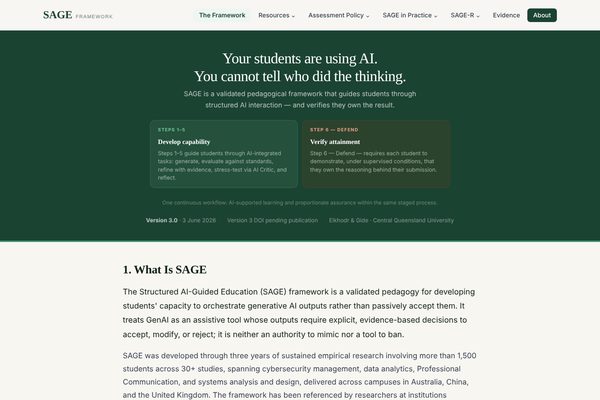 Pedagogy
SAGE Pedagogy (opens in a new tab)
I designed a six-step cycle (Generate, Evaluate, Refine, AI Critic, Reflect and Defend) that puts judgement at the centre of learning with AI. Students begin with their own thinking and finish by defending it.
-
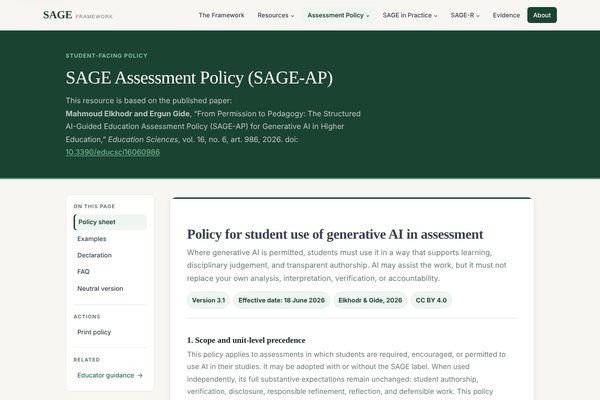 Assessment policy
SAGE-AP (opens in a new tab)
SAGE-AP answers the question every educator asks: what AI use is permitted, and what must students show? It sets clear expectations for authorship, verification, disclosure and defensible work.
-
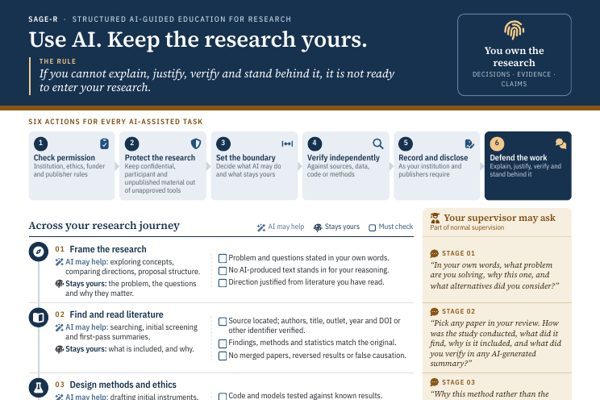 Research supervision
SAGE-R (opens in a new tab)
I extended SAGE to higher degree research. Use, Own and Defend give supervisors and candidates practical guidance for working with AI.
- Since 2022 classroom development
- 1,500+ students, 2,210 CQU enrolments
- 40+ peer-reviewed publications
- 3 TEQSA Knowledge Hub resources
Where to begin
The SAGE website hosts a much larger set of resources. A selection is linked here, and all are shared under a CC BY 4.0 licence. Explore the other resources on the SAGE website (opens in a new tab).
-
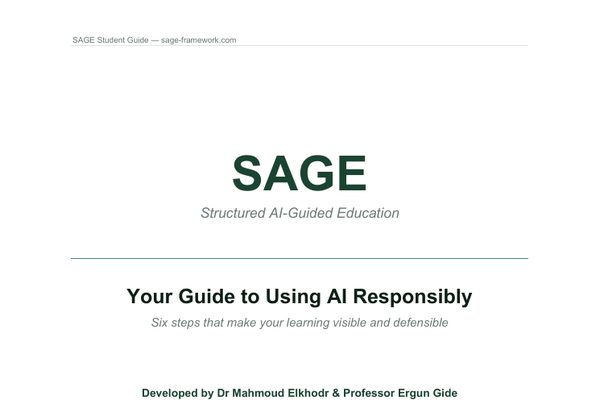 Students
SAGE Student Guide (opens in a new tab)
A six-step guide to responsible AI use, with preparation for Defend. A PDF edition is available for printing and record keeping.
-
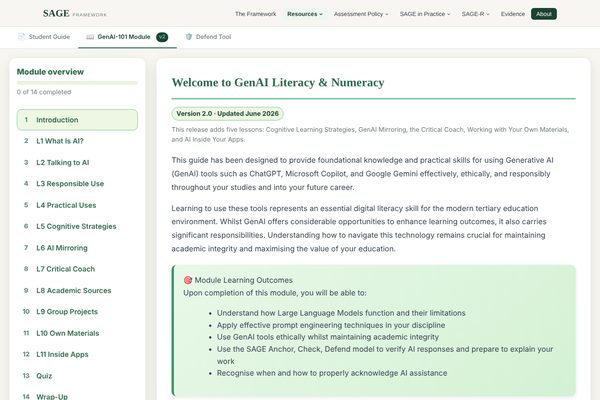 AI literacy
GenAI-101 (opens in a new tab)
An eleven-lesson module on learning with AI, critical coaching, source checking and working with AI inside applications. It is listed in the TEQSA Generative AI Knowledge Hub.
-
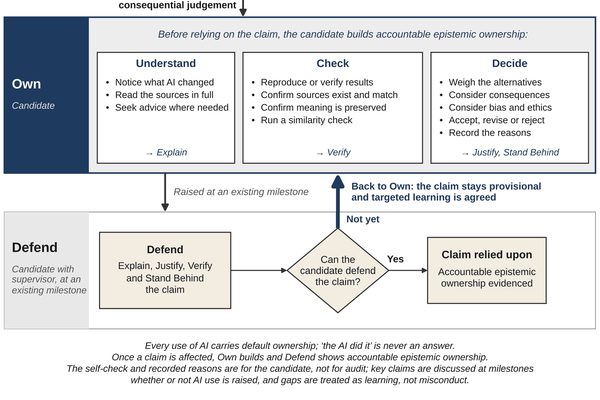 Assessment assurance
Defend Tool (opens in a new tab)
Supports the design of proportionate checkpoints in which students explain, justify, apply or adapt their work, matched to the capability, the discipline and the cohort.
-
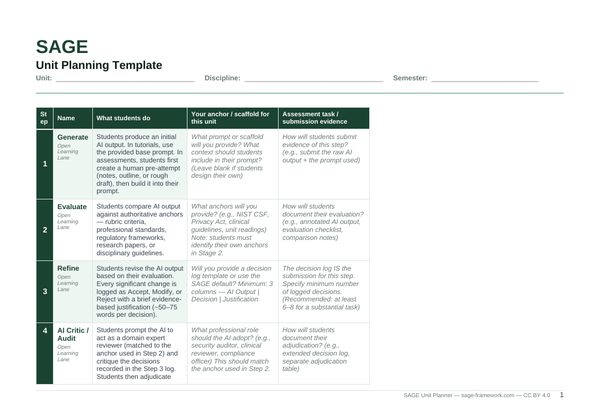 Educators
Downloads and starter kit (opens in a new tab)
Guides, the unit planning template, the assessment rubric and other implementation resources, in PDF and Word formats.
Core framework papers
The full record, with study methods, limits and student dashboards, is on the SAGE evidence page (opens in a new tab) and the Publications page.
- STEM Education · 2026A pedagogy for AI orchestration and assessment assurance (opens in a new tab)The six-step framework and its distributed Assurance by Design architecture.
- Education Sciences · 2026From permission to pedagogy (opens in a new tab)The SAGE Assessment Policy (SAGE-AP) for generative AI in higher education.
- Discover Education (Springer Nature) · 2025The SAGE Framework for Developing Critical Thinking and Responsible Generative AI Use in Cybersecurity Education (opens in a new tab)The framework applied to a cybersecurity education setting.
Institutional and international use
Three SAGE resources are also listed in the TEQSA Generative AI Knowledge Hub as sector-wide good practice (see Publications).
-
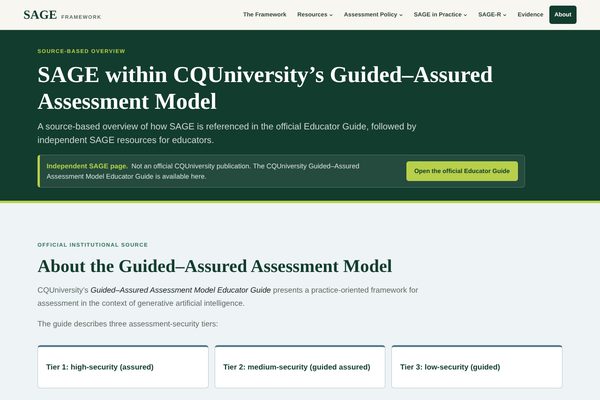 Institutional incorporation
CQUniversity (opens in a new tab)
The official Guided–Assured Assessment Model Educator Guide includes the SAGE cycle and Student Orchestration Levels. The Academic Learning Centre also lists GenAI-101 among its student resources.
-
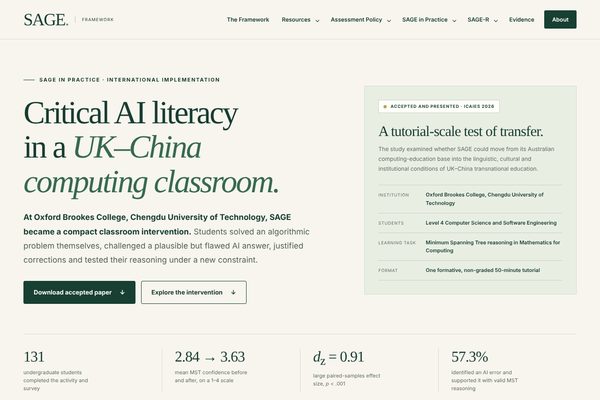 International implementation
Oxford Brookes College and Chengdu University of Technology (opens in a new tab)
A SAGE-guided computing intervention extends the research into transnational education and disciplinary error checking.
-
 Program overview
From AI use to student judgement (opens in a new tab)
A short video (2 min 58 s) introducing the development of SAGE, student learning and wider use, with the accompanying written evidence.
Citing and adopting SAGE
Suggested citation (IEEE)
M. Elkhodr and E. Gide, “The SAGE Framework: Structured AI-Guided Education,” Central Queensland University, 2026. doi: 10.5281/zenodo.18383951.
Developed by Dr Mahmoud Elkhodr and Professor Ergun Gide, CQUniversity Australia. Enquiries about pilots, implementation and collaboration are welcome through the contact page.