In this third article for The Conversation I examine seven major technology incidents in six days, from Microsoft’s global outage and a nationwide US aviation ground stop to bank transaction problems, an Apple outage and a supply-chain attack on software used by well-known websites. I ask whether the week was a coincidence, and set out what the reported causes show: only one of the seven is confirmed as a cyberattack, while the reported causes of several others point to routine changes such as updates and new equipment. I argue that data-hosting rules and agreements with global providers cannot keep essential services running when those providers fail, and I propose three measures: targeted sovereign technological capabilities, meaning pre-configured and regularly tested local systems for essential services; a say over how global providers roll out changes to them; and independent review of major failures, not only those labelled cyberattacks.
In a report for news.com.au, also published in the Herald Sun, journalist Harrison Christian interviewed several experts on the economic and policy consequences of the Microsoft outage, and included my comments. I advised that organisations should identify their essential operations and establish independent alternatives that have been tested. I also argued that keeping data in Australia is not the same as keeping Australian services running, because locally hosted systems may still depend on global authentication, networking or management infrastructure, so digital sovereignty must include operational independence. Finally, I noted that Microsoft attributed the outage to a network upgrade rather than a cyberattack, and that the biggest risk to essential services may be the changes made to our own systems.
In its own news explainer on the global Microsoft outage, Euronews drew on my analysis in The Conversation, describing me as a senior lecturer in information and communication technologies at CQUniversity. The report relays my suggestion that automated health checks, which normally remove faulty servers from service, may have malfunctioned and switched off healthy ones, overloading the remainder, and notes that I presented this as an inference from Microsoft's public updates. It also reports my point that a distributed denial-of-service attack, which floods a system with outside traffic, does not fit Microsoft's statement that traffic had not increased. Finally, it cites my advice that organisations should plan for digital outages as they would for natural disasters, with backup systems that are tested regularly, and that individuals keep essentials such as contacts available offline.
(opens in a new tab)Screenshot: Euronews, captured 16 November 2026 (opens the article)
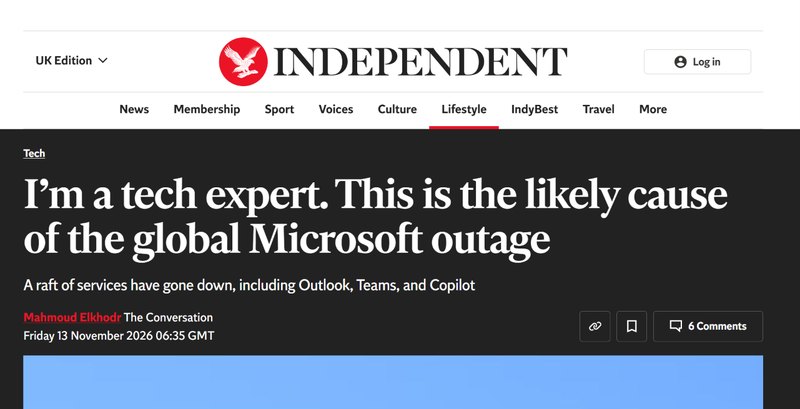
The Independent republished my article from The Conversation on the global Microsoft outage under a new headline, as part of its technology coverage. The article explains why the evidence does not suggest a cyberattack and why a more mundane cause, in which faulty health checks withdraw healthy servers, fits better, while noting that this remains an inference until Microsoft publishes a post-incident review. It also argues that individuals and organisations should plan for digital outages as they do for bushfires, with offline essentials and backup plans that are tested in practice.
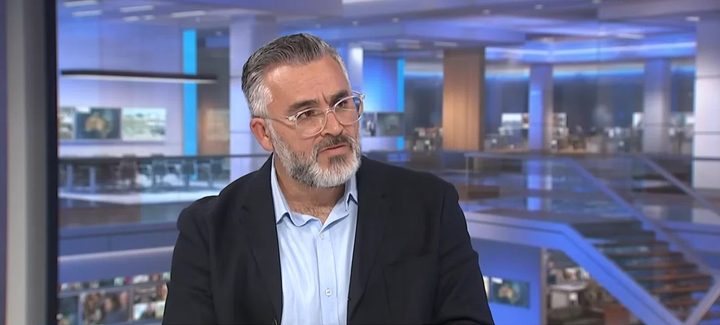
ABC News reported my interview on the ABC News Channel in its live coverage of the global Microsoft outage. I said it was too early to judge how big the outage could become, and that a failure of this kind would have been very difficult to avoid. Cloud services remain valuable, but reliance on one underlying technology is their downside. Organisations and individuals should identify the essential services that must keep running, arrange alternatives from a different provider, and test them, because an untested plan is likely to fail during a real outage.
Image: ABC News (opens in a new tab)Screenshot: The Independent, 13 November 2026 (opens the article)
A global Microsoft outage stopped email, cloud storage and collaboration tools for many users, with effects that reached family violence services, schools, telehealth and government service centres. It even disrupted AI tools that connect to Microsoft 365. In this article for The Conversation I explain why Microsoft's account of the failure shifted and why the evidence does not suggest a cyberattack. A more mundane explanation, in which faulty health checks withdraw healthy servers, fits better, but it remains an inference until a post-incident review is published. I argue that individuals and organisations should prepare for digital outages as they do for bushfires, with offline essentials and backup plans that are tested in practice.
The international edition of Greece's To Vima newspaper cited my analysis in The Conversation of the global Microsoft outage. The report draws on it to explain how several services can fail at once when they depend on shared systems, and to argue that digital outages should be prepared for in the same way as natural disasters. It describes me as a lecturer in information and communication technology at CQUniversity in Australia.
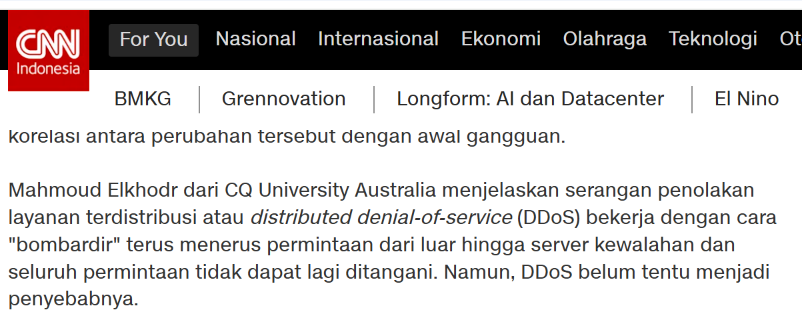
CNN Indonesia, in an Indonesian-language report headlined “Microsoft Down Globally, Expert Reveals Suspected Cause”, drew on my analysis in The Conversation of the global Microsoft outage. It relays my suggestion that automated health checks may have wrongly removed healthy servers, leaving the remainder overloaded. It also reports that a distributed denial-of-service link is hard to establish, because Microsoft reported no rise in traffic, no evidence of malicious activity and no claim of responsibility. It closes with my advice to keep essentials such as contacts offline and to prepare for digital disruption as for natural disasters.
(opens in a new tab)Screenshot: CNN Indonesia, captured 16 November 2026 (opens the article)
Renaming a home Wi-Fi network is a sensible first step, but the larger task is now supervising how AI controls the smart home. In this CQUniversity News story, changing the network name is compared with taking a name off the letterbox rather than locking the front door. A default name can reveal the internet provider or the router model, and an insecure network can expose cameras, baby monitors and other connected devices. A default router administrator password is a common mistake, and AI assistants connected to the home add new risks of their own. The story closes with five practical steps for staying cybersafe.
A complete internet blackout is unlikely, because the network is built from many cables, wireless links and satellites that can route around failures. The more realistic risk is that many services fail together because they depend on the same shared system, such as a single sign-in provider. A recent flaw in PHP showed how one vulnerability can take many websites offline, and AI tools are making such flaws easier to exploit. In this article for The Conversation I describe what that could look like, from a cyberattack on health systems that delays insurance claims while clinics keep seeing patients, to email, documents and learning platforms failing at the same time. I also set out how organisations can prepare with a tested incident response plan, and how households can keep essential information offline, know alternative ways to sign in, communicate and pay, and test their backups. I discussed these questions in a radio interview with ABC Southern Queensland, which is featured on this page.
Researchers increasingly ask AI tools to find and summarise the literature, and the answers read as authoritative. Tests of those summaries found missing or misattributed authors, incomplete references and inaccurate accounts of what the studies actually found. The practical lesson is that a fluent summary is not evidence that a paper says what the summary claims, so every claim that matters must be checked against the original source. This is the same issue that SAGE-R addresses for graduate researchers, who must understand and verify a claim before relying on it. The story was published by CQUniversity News.
This feature explores how AI is reshaping work and why AI literacy, critical thinking, human judgement and continuous learning matter for graduates. It also describes how SAGE approaches the responsible use of AI in learning.
Universities have responded to generative AI mainly through policy and integrity warnings. These are necessary, but students are asking for something more practical: how to verify AI output, how to write a good prompt and how to avoid breaching the rules by accident. This article, published in HERDSA Connect, draws on research with first-year ICT students at CQUniversity. It shows that when students are given structured verification requirements, they check AI output systematically and revise it substantially instead of making cosmetic edits. It also notes that confidence in English is a major reason students turn to AI, so a blanket ban can remove a useful support for linguistically diverse students. The article sets out the SAGE workflow for assessments where AI use is permitted, with a decision log and a critique stage, and suggests that educators start small with a permitted-use statement and rubric criteria that reward the quality of justification.
Today's smart cities collect data for people to interpret. In my book, Next-Generation Smart Cities, I argue that the next step is cities in which networks of autonomous AI agents reason, act and coordinate with each other in real time. Traffic is a simple example: instead of reporting congestion to a control room, intersections could coordinate directly with buses, ambulances and neighbouring roads. The book also examines how blockchain and future 6G networks could help protect connected infrastructure. The harder questions concern accountability. If an autonomous system makes a faulty decision in a hospital, a transport network or a power grid, it is not clear who is responsible, and trust, safety and ethical design must be settled before these systems become embedded. CQUniversity News published this feature on the book.
Co-authored with Professor Ergun Gide for Times Higher Education Campus, this piece argues that policies, warnings and bans are not enough. A policy sets boundaries but does not teach students how to verify AI output, and it overlooks the way AI can help students from linguistically diverse backgrounds take part more fully. We present SAGE as a practical alternative: students generate a response, evaluate it against authoritative sources, refine it with a logged decision to accept, modify or reject, use AI as a critic, reflect, and defend their work in a short supervised task. We also offer a seven-step guide for applying the approach to any unit, including weighting assessment towards process rather than the final product, and we recommend that educators begin with a permitted-use statement, a simple decision log and rubrics that judge the quality of justification.
Many universities are reacting to generative AI by returning to invigilated exams, handwritten tasks and oral checks. In this opinion piece for Future Campus, I argue that this overcorrects. Exams often reward recall under pressure, can disadvantage students with anxiety or language barriers, and rarely resemble how graduates work. Because graduates will use AI and remain accountable for its output, assessment should test their evaluative judgement in AI-rich settings. I propose distributed assurance: rather than one secure format for every unit, each subject includes supervised checkpoints suited to its discipline, such as a viva, a code walkthrough or a live demonstration. SAGE puts this into practice through its final Defend step, in which students show ownership of their reasoning.
CQUniversity's resources on responsible AI use now appear on the TEQSA Generative AI Knowledge Hub, where they serve as reference material for the sector. This news story reports the recognition, which rests on more than two years of peer-reviewed research across several campuses and online. Rather than restricting or detecting AI use, the approach teaches students to evaluate, challenge and refine AI-generated content with professional judgement. SAGE was developed with Professor Ergun Gide, and in the story I make the case for flexible frameworks rather than static policies, because AI is changing quickly. The story also describes a community of practice that is extending the work to other educators.
Preprints trade early visibility for some control over a research claim, and generative AI changes the terms of that trade. This article examines how AI alters three risks: sharing a preprint publicly, entering unpublished research into AI tools, and using AI during peer review. It was first published on LinkedIn and is archived with a DOI.
Universities cannot reliably detect AI use, and banning it is unrealistic when employers expect graduates to work with it. In this opinion article, CQUniversity researchers argue that the real question is whether students understand what they submit. The answer offered is SAGE, a six-step learning cycle: students generate a draft with AI, check it against professional standards, correct its errors, have the AI critique the revised work, reflect on where the tool succeeded or failed, and defend their competence in a short supervised task. The article also points to the regulator's recommendation to combine open assessments that build AI skills with secure assessments that verify independent knowledge. It was republished by The Educator.
This institutional impact case study describes how SAGE, which Professor Ergun Gide and I created, is helping CQUniversity adopt generative AI responsibly. SAGE teaches students to use AI within their discipline and to check, refine and defend what it produces, and it rests on peer-reviewed studies with more than 1,500 students in Australia, China and the United Kingdom. The case study also describes the AI-Powered Pedagogy Toolkit. Both are available through the TEQSA GenAI Hub.
A candidate who begins a PhD this year will graduate around 2030, in a world where AI is part of everyday research practice. The question for graduate research is therefore no longer whether candidates will use AI, but whether they will be equipped to use it well. Guardrails tell candidates what is permitted, but they do not show how to do sound research alongside AI. In this article I argue that the difference lies in what AI does to a research claim. Most assistance, such as finding papers, fixing code or tidying prose, leaves the claim unchanged. Sometimes, however, AI shapes the claim itself, and SAGE-R calls that moment the ownership threshold. SAGE-R is the research supervision extension of SAGE that I developed with Professor Ergun Gide. It gives candidates and supervisors a shared way to check, decide and explain what they rely on, and every resource is open.
When billions of dollars leave a cryptocurrency exchange, it is fair to ask what happened to the security that blockchain was supposed to provide. I teach blockchain at CQUniversity, and this article uses the Binance incident to answer that question in plain terms. A blockchain protects the shared record of transactions, but an exchange holds its customers' keys and approves transfers through its own internal systems. On the evidence reported so far, attackers appear to have compromised those systems and caused them to authorise payments that carried genuine signatures, so the blockchain itself was not broken. The lesson is that a decentralised network can still depend on one centralised approval process, which then becomes a single point of failure. I explain what a wallet actually holds, how a transfer is authorised and the controls that could contain the damage, themes that are developed further in my book on smart cities.
What is shared with an AI tool may leave the author's control, and an unpublished idea that is retained or used in training could resurface in someone else's answer, uncredited. This poster sets out six checks to make before sharing: whether the contribution is worth protecting, whether the material is sensitive, whether policy and permission allow the use, how the service trains on and retains inputs, how far an AI agent should be fenced in, and whether a brief, dated description would serve instead. It was prepared with Professor Ergun Gide for Cyber Security Awareness Month and first appeared in CQUniversity's Researcher Essentials in October 2026.
The SAGE paper in Discover Education is indexed in ERIC, the education research database of the United States Department of Education's Institute of Education Sciences. The paper, written with Professor Ergun Gide, introduces SAGE, a framework that uses generative AI responsibly to build critical thinking in cybersecurity education. Students first use AI in tutorials to produce, evaluate and improve security policies, and then apply AI outputs to realistic industry cases in assessments. The authors report improved ability to assess policies and refine risk assessments, alongside over-reliance on AI and uneven AI literacy, and they stress the need for human oversight.
Scienmag reported on the SAGE paper published in Discover Education, written with Professor Ergun Gide. The article presents SAGE as a guide for educators and institutions designing cybersecurity curricula that keep pace with technological change, so that students understand both the potential and the risks of generative AI. It describes analytical projects that examine how AI and cybersecurity problems relate, including their wider consequences and ethical implications, and it highlights collaboration among schools, industry and policymakers. It also notes the emphasis the framework places on law, psychology and ethics alongside technical skills.
The University of Warwick lists the preprint on generative AI in cybersecurity education, written with Professor Ergun Gide, in its Education Fund project directory, where Dr Mahmoud Elkhodr and Professor Gide are named as researchers. The page summarises the two-stage approach of tutorials followed by assessments, the reported gains in critical thinking and analytical skills, and the challenges of over-reliance on AI and uneven AI literacy. The summary on the page is machine generated, and it links to the original preprint, which later developed into the SAGE paper published in Discover Education.
This report covers a study by Professor Ergun Gide and me that introduces SAGE for cybersecurity educators. The framework helps students think critically about generative AI and use it responsibly, through projects that examine how AI tools relate to security problems, their wider consequences and the ethical responsibilities involved. Case studies, simulations and hands-on exercises make the ideas concrete. The study also calls for collaboration between universities, industry and policymakers, and addresses risks such as misinformation, bias and automated attacks.
A teaching blog from the Centre for English Language Communication at the National University of Singapore draws on the 2023 STEM Education paper on ICT students' perceptions of ChatGPT, written by Dr Mahmoud Elkhodr with Professor Ergun Gide, Ruby Wu and Omar Darwish. The post reports a survey of 39 students in an English communication course, who valued ChatGPT for summarising texts and gathering ideas but noted concerns about accuracy and cheating. It cites the paper twice, first to support the benefit of ChatGPT as a learning resource and again to support the finding that students perceive its output as a useful learning resource.
A European Parliament in-depth analysis of the use of artificial intelligence as a weapon of repression, requested by the Parliament's Subcommittee on Human Rights and published in May 2024, is listed in SciVal as citing a 2023 conference paper on identifying fake news in the Russian-Ukrainian conflict using machine learning. The paper, led by Omar Darwish with Dr Mahmoud Elkhodr among the co-authors, appeared in Lecture Notes in Networks and Systems from AINA 2023. It compared a pre-trained BERT model with five classical classifiers on a labelled dataset of tweets, and found that support vector machines and logistic regression performed best, at about 76 per cent accuracy. The analysis was also issued by the EU Publications Office.
Comments on Earth 2, a platform selling virtual plots of land that mirror real places, describing it as a form of metaverse in a news story on people spending large sums on virtual land resembling Central Queensland.
A report of the Academy of the Social Sciences in Australia, held in the Australian Policy Online repository and listed in SciVal as a policy document that cites Dr Elkhodr's research.
A recorded course-advice session from my former role as Academic Manager and Postgraduate Course Coordinator at Victoria University Sydney. Included as a historical record of academic leadership.