A live interview on the global Microsoft outage, why its cause was hard to identify, and what organisations can do when essential systems are unavailable.
An Evenings interview with Helena Shield on the recent run of major tech outages, how much is human error and how much is attack, and what governments and individuals can do to prepare.
25 November 2026 · 13 min 25 sec
Audio unavailable here. Please use the original ABC player below.
A Sunday Morning interview with Sally Rope, broadcast across ABC regional Queensland stations, on the recent run of major outages and whether they are connected.
22 November 2026 · 10 min 50 sec
Audio unavailable here.
ABC Southern Queensland · Radio interview
Could the internet go down?
A radio interview on online service outages and what they could mean for regional communities and businesses.
November 2026 · 10 min 4 sec
Audio unavailable here.
ABC NewsRadio · Radio interview
Remote work and the rise in cybercrime
An interview with Glen Lauder on cybersecurity risks as more people worked from home.
20 October 2020 · 5 min 37 sec
Audio unavailable here. Please use the original ABC player below.
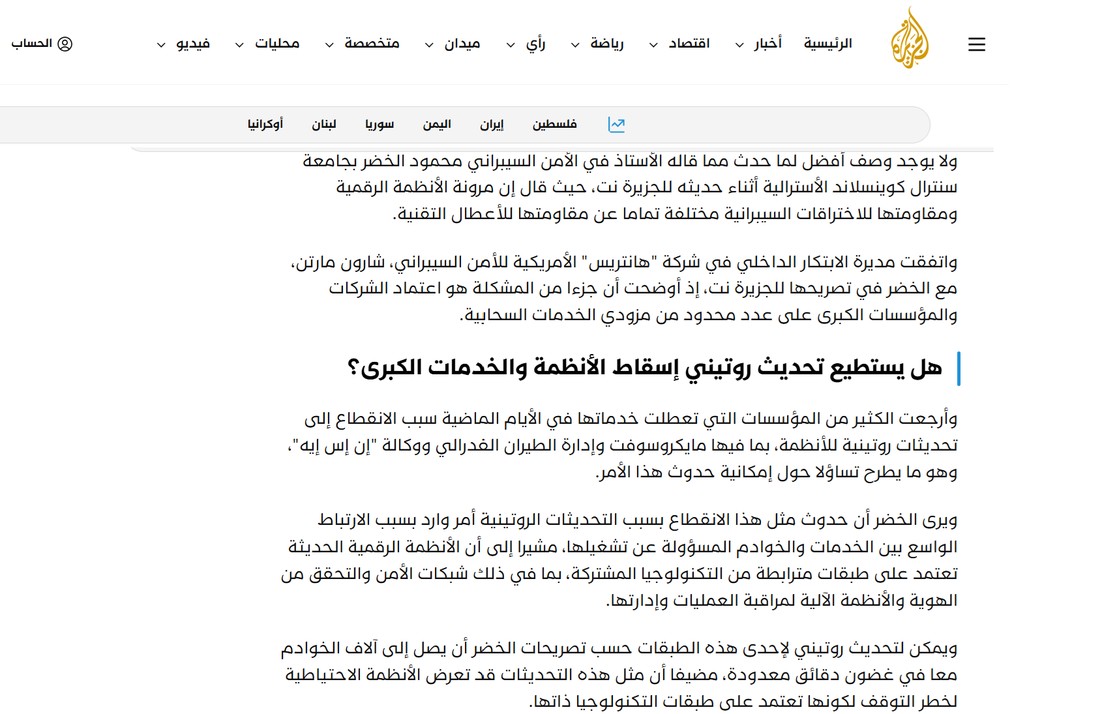
Al Jazeera Net, in an Arabic-language feature headlined “7 outages in 6 days: why are America’s services collapsing? Experts answer”, builds its explanation of the recent run of technology failures largely on my analysis, with comments from other experts alongside. It opens with my point that resilience to cyberattack and resilience to outage are very different things, and relays my explanation that modern services rest on shared layers of technology, that a routine update to one layer can reach thousands of servers within minutes, and that long-hidden faults and automated recovery can make matters worse. It sets out my position that coincidence, shared weaknesses and deliberate attack are not mutually exclusive explanations, that the timing is notable but is not evidence of coordination, and that no public evidence yet links the incidents. It closes with my advice for users and institutions: avoid relying on a single digital service for essential matters, keep important documents and emergency contacts offline, identify the essential operations that can continue without internet or cloud access, and rely on official provider channels, because major outages attract scammers. The article introduces me as an academic in cybersecurity at CQUniversity in Australia.
(opens in a new tab)Screenshot: Al Jazeera Net, captured 23 November 2026 (opens the article)
In a report for news.com.au, also published in the Herald Sun, journalist Harrison Christian interviewed several experts on the economic and policy consequences of the Microsoft outage, and included my comments. I advised that organisations should identify their essential operations and establish independent alternatives that have been tested. I also argued that keeping data in Australia is not the same as keeping Australian services running, because locally hosted systems may still depend on global authentication, networking or management infrastructure, so digital sovereignty must include operational independence. Finally, I noted that Microsoft attributed the outage to a network upgrade rather than a cyberattack, and that the biggest risk to essential services may be the changes made to our own systems.